In today’s video titled Failed Robbery: Off‑Duty Officer REACTS to attempted robbery and shoots criminal, viewers are thrust into a dramatic, real‑life encounter where one decision changed everything in a matter of seconds. The phrase “failed robbery” sets the stage: an attempted crime that did not succeed. The descriptor “off‑duty officer reacts” brings an additional layer of intrigue, because it highlights how the ordinary boundaries of a work shift and personal time can collapse in an instant. Finally, “and shoots criminal” signals the ultimate escalation: force used, a life‑and‑death decision made in split‑second context.
From the very start, you sense the tension. The would‑be robber makes a move, probably expecting a quick payoff, maybe under the assumption that things would go smoothly. But events don’t unfold as planned. The off‑duty officer — someone who, though off the clock, still retains training, awareness, and readiness — assesses the situation, reacts, and intervenes. What follows is a collision of expectation and reality: the criminal’s plan versus the officer’s response. The “shoots criminal” part is not mere sensationalism: it reflects a pivot point where the incident moves from attempted theft to armed confrontation.
Watching this, one is struck by the interplay of roles: robber versus citizen, criminal versus law‑enforcement (albeit off duty). The officer’s reaction is key: how did she or he first become aware? Was there an instinctive leap into action? Did training kick in? The video gives us an immediate, raw insight into how quickly things can escalate. There’s no prolonged build‑up; in many cases, what looks like a routine encounter becomes a crisis in seconds. The title underscores this: a robbery attempt, an off‑duty officer, a shot fired.
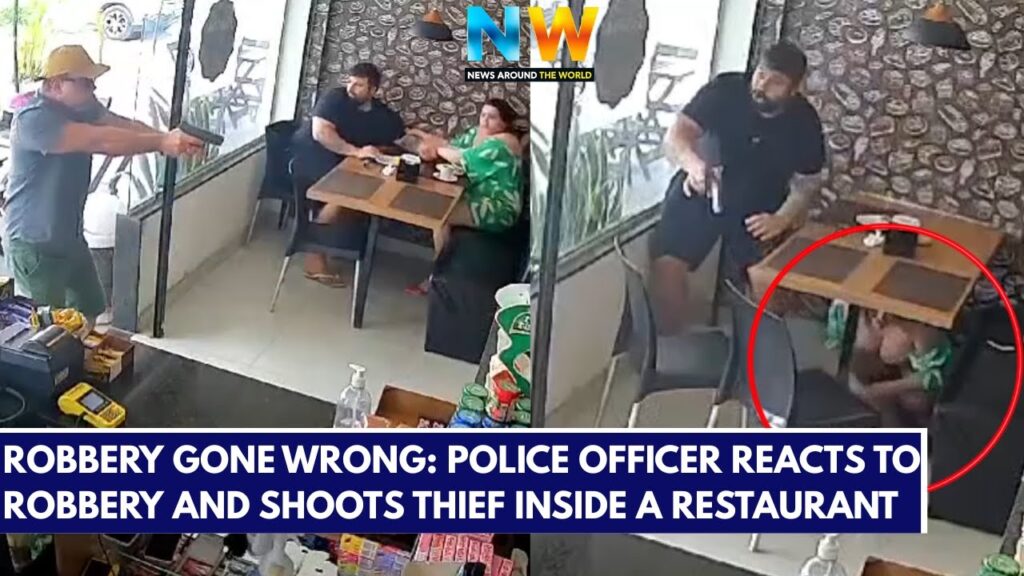
Importantly, the “failed robbery” frame invites reflection: failure on the part of the criminal, success (in a sense) on the part of prevention. But it’s not simply a victory narrative — there is risk, consequence, high stakes. When the officer shoots the criminal, that move carries heavy responsibilities: was lethal force justified? What were the circumstances? The video offers an unfiltered look at real‑world policing outside of the uniformed setting. The term “off‑duty” reminds the viewer that law‑enforcement does not pause when the badge is off‑time — in some situations, same training and same hazards apply.
Another strong aspect of the title is the word “reacts”. It suggests immediacy, authenticity, a moment captured without the luxury of deliberation. Viewers expect to see genuine human reflexes: threat perceived, decision made, action executed. And that is compelling. We watch not just a crime, but the human response to crime: not the planned, scripted security footage, but a lived moment where the actor is an off‑duty officer, perhaps in civilian clothes, making a life‑saving move.
Let’s talk about implications. For the general viewer, this video underscores how one’s safety, the safety of others, and the possible futility of crime all come together. The “failed robbery” shows that crime doesn’t always succeed. The “off‑duty officer reacts” hints at preparation, courage, presence of mind. The “shoots criminal” signals that in some situations, escalation is swift and serious. The sequence raises questions: Could the robbery have succeeded? Was the officer’s intervention timely? How did others nearby respond? What can we learn about situational awareness?
From the education side, this video offers a case study. For security professionals, everyday citizens, and armchair analysts alike, it becomes instructive: what did the criminal overlook? Why did the robbery fail? What opportunities did the officer seize? Did the off‑duty nature of the officer change the dynamics? Did visibility, surprise, or training play a role in the outcome? These are the lessons beneath the spectacle.
But there’s also emotional weight. When someone fires a shot — even when justified — lives shift. The criminal is interrupted, likely injured or incapacitated. The officer — though trained — must carry the burden of that moment. Witnesses may be traumatized. The video invites empathy, reflection: What happens next? How does the community respond? How will this event ripple outward? The title’s matter‑of‑fact phrasing (“shoots criminal”) belies the seriousness of that action.
For viewers of crime‑footage or reaction videos, this is high‑drama content. It combines a real‑world crime attempt, an unexpected hero in civilian mode, and the hearing of a gunshot. It’s compelling not because it’s sensationalized, but because it’s authentic. The fact the officer was off duty adds a layer of everyday‑person stakes — the hero wasn’t summoned officially — they acted. That resonates. It suggests: ordinary people, prepared and present, can make a difference.
From a channel‑perspective, the title works because it sets expectations clearly: viewers know they’re getting a crime attempt, an intervention, a shooting. That clarity helps with discoverability (people searching for “robbery attempt”, “off‑duty officer saves”, “robbery fail”, etc.). The inclusion of “off‑duty officer reacts” and “shoots criminal” adds hook‑phrases that engage curiosity. Why “reacts”? What “shoots”? Who? So viewers click.
One might ask: is the title respectful? Does it handle the severity appropriately? I believe so. It describes, rather than sensationalizes. “Failed Robbery” is factual. “Off‑Duty Officer Reacts” denotes action, not hero worship. “And shoots criminal” acknowledges a serious outcome. It sets the stage without hyperbole.
For optimization, this title could also benefit from minor tweaks depending on search intent. For example: “Off‑Duty Officer Stops Robbery: Suspect Shot in Failed Armed Robbery”. This adds “armed robbery” and “suspect shot” phrases that might match search patterns. But the original title you asked for captures the essence fine.
In summary, Failed Robbery: Off‑Duty Officer REACTS to attempted robbery and shoots criminal gives viewers exactly what they expect: a dramatic crime attempt, an unexpected intervention, a serious resolution. It invites attention, prompts reflection, and delivers real‑world stakes. It’s the kind of video that is both thrilling and sobering. If you’re drawn to true‑life security footage, policing action, or the dynamics of crime and prevention — this is a compelling piece.