The 2025 edition of the Grand Prix de l’UET (Groupe I), held at the Hippodrome de Solvalla in Sweden on 11 October, stands out as a thrilling chapter in European harness-racing history. Wikipedia+3UET Trot+3Province Courses+3 The event brings together the continent’s best four-year-old trotters (excluding geldings) that were entered from birth and confirmed through successive years. Wikipedia+1
From the outset, the Grand Prix de l’UET carries immense prestige. Created in 1985, it is reserved for four-year-old trotters (excluding geldings) from the stud-books of countries affiliated to the Union Européenne du Trot (UET). Wikipedia+1 The race covers around 2,100-2,140 metres and is run behind the auto-start; the prize fund historically is in the region of €400,000, with about half to the winner. Wikipedia
In 2025, Solvalla again hosted the finale, and the standout performer was the trotter Dream Mine, driven by the talented Swedish driver Mats E. Djuse and trained by the Swedish-born, France-based trainer Jörgen Westholm. Province Courses+1 Dream Mine clocked a remarkable time of 1’10’’6, registering what many regarded as an exceptionally strong performance for a four-year-old in this event. UET Trot+1
What makes this edition memorable is the combination of dominance, strategy, and pedigree. Dream Mine, son of the champion sire Maharajah (a Prix d’Amérique winner), was already showing serious form having cleared his elimination heat at Åby in late September. Province Courses Starting from the favourable inside gate (couloir 1), he sprang to the front right away and took control of the race from the first stride. From there, he was never headed, establishing a rhythm that his rivals found difficult to counter. The driver’s command of both horse and race dynamics was evident, and the win was described by Westholm as “fantastic… I believe he is the horse of my life.” Province Courses
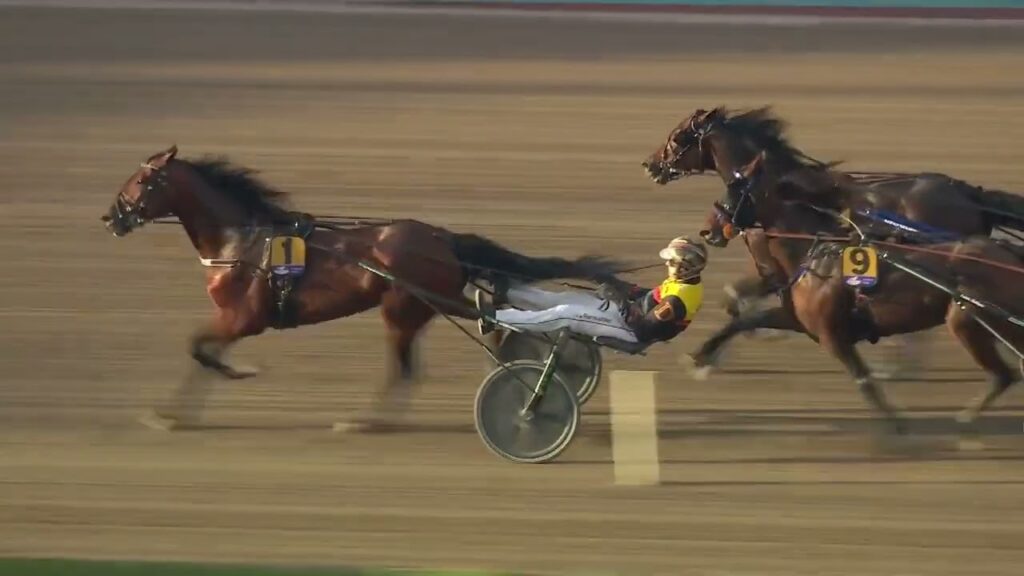
From a tactical perspective, the start in an auto-start race is often crucial. Dream Mine’s immediate jump to the lead allowed him to dictate the pace rather than being drawn into chasing others. In many European harness races, a front-rank position can enable a trotter to avoid traffic, reduce psychological stress and maintain rhythm. As conditions at Solvalla on 11 October likely favoured front-running, the blueprint to lead early was spot on.
Looking further, the time achieved (1’10’’6) is significant for this age and stage. According to UET records, the winning times at this event have hovered around similar figures, but Dream Mine’s run appears among the fastest. UET Trot+1 The achievement underlines a combination of raw speed, stamina, and tactical maturity beyond what many onset four-year-olds deliver.
From the vantage point of European trot enthusiasts, this win carries extra meaning. Sweden has a rich history with this event: as the host nation multiple times, and with many past winners. Dream Mine’s victory continues that tradition and reinforces the strength of Swedish training and breeding programmes in international trot. Province Courses+1 For the trainer Westholm, rearing the horse from birth and being present at each step — as he openly revealed — adds a rich emotional dimension to the victory.
Beyond the winner, the race also shines a light on the broader field. The fact that elimination heats take place across Europe before the final adds depth and continental flavour to the event. The UET stipulates that entrants must be confirmed at various stages: as two-year-olds, three-year-olds, and then again in the year of the race. Wikipedia+1 That means by the time the final rolls around, the field has already been filtered for quality and resilience.
For viewers of the YouTube link you shared, this particular broadcast gives excellent insight into elite-level harness racing: you see the build-up, the elimination context, the gate draw, the start, the trotters’ break‐points, how the driver maneuvers into an advantage, and ultimately how Dream Mine sustains the lead and crosses the line first. It’s a good educational piece for anyone wanting to understand the sport’s nuances: gait discipline, race tactics, race tempo, driver decisions, and how these interact in a high-stakes continental final.
One particular point worth emphasising: at Solvalla, the track configuration (distance ~2,140 m for this edition) and the quality of the field meant that maintaining a high average speed without breaking gait is essential for success. A misstep, a break in trot, or getting boxed in can cost seconds that at this level can mean the difference between victory and also-ran. Dream Mine’s unblemished performance underlines how clean execution is non-negotiable in such events.
Moreover, the win opens doors. For a top four-year-old like Dream Mine, winning the Grand Prix de l’UET not only bestows European champion status in the age category, but also increases value as a breeding prospect, raising his standing for future engagements and in the sport’s broader ecosystem. The trainer’s suggestion of maybe heading to France for further engagements underlines that pathway. Province Courses
In summary, the 2025 finale of the Grand Prix de l’UET was a showcase of excellence in European trot racing: top-tier breeding, elite driving, refined race tactics, top physical conditioning, and a driver-horse partnership that delivered when it mattered. The particular video you have captures this moment — a compelling watch for fans of harness racing, European sport, or anyone curious about high-level equestrian competition.
If you like, I can pull together highlights (in text form) of the race – key moments, splits, and driver commentary – from the broadcast. Would you like that?