In this enthralling video you’re about to watch — “I Caught a MONSTER Fish and Cooked It Outdoors! Best Fish Recipes” — we join an outdoor adventure that fuses the thrill of the catch with the immediate satisfaction of cooking fresh from nature. The story begins upstream, in a scenic river setting, where our host sets out with rod, line, and an eye for a big prize. After what looks like hours of careful waiting, line‑tension, and the adrenaline rush of “Is it the big one?”, the moment comes: the monster fish takes the hook, the fight commences, and the natural spectacle unfolds.
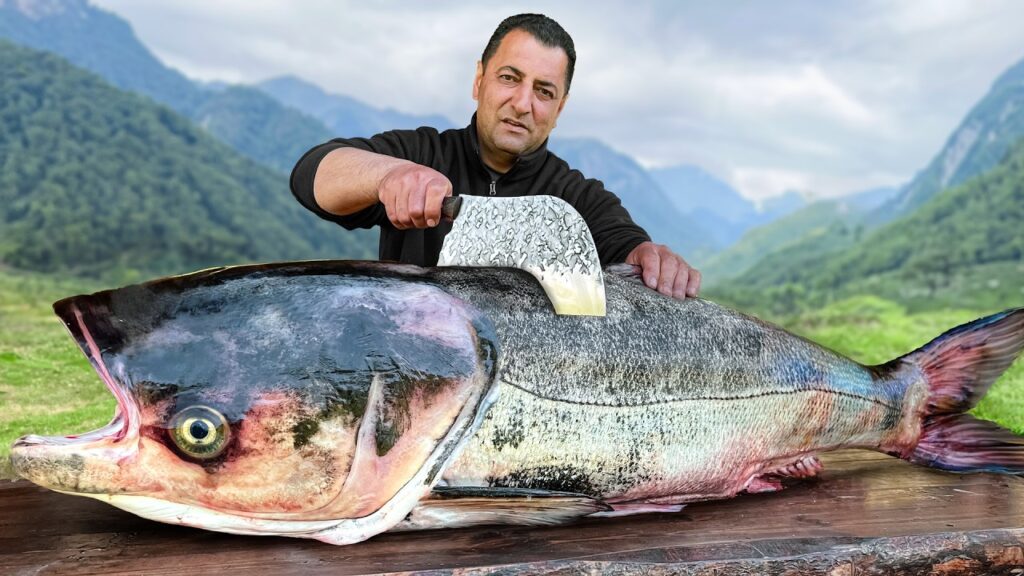
The size of the fish is impressive — hence the term “monster” in the title is apt. It’s not just about size though: the video emphasizes the connection between angler and environment, showing the clear waters, the bank of the river, the vegetation, and the solitude of the setting. It reminds us that fishing is not just about the end result, but about the process, the patient wait, the quiet surroundings, the moment when everything aligns.
Then comes the transition: once the fish is landed, our host doesn’t haul it away to a kitchen far removed from nature. Instead, they stay right there — outdoors — mid‑stream or by the bank, building a fire, preparing the fish on the spot, seasoning it, perhaps cleaning it in nature’s stream water. This practical, genuine outdoor cooking segment is a big part of what makes this footage compelling. The fish is docile in the pan, the crackle of the fire is audible, the steam rises, and the aromas almost come through the screen. The visuals of fresh fish turning golden‑brown, crispy edges forming, herbs and seasoning being sprinkled — these are tactile, sensory moments.
From a recipe perspective, there are a few standout features:
- The host likely shows how to scale, gut, fillet or otherwise process the fish right after catching it. That immediacy gives authenticity.
- The cooking method is simple and rustic — no high‑end kitchen equipment, but rather the elements: fire, pan, fresh fish, minimal fuss. This appeals to a wide audience: fishing fans, outdoor cooking enthusiasts, survival‑type viewers, or just anyone fascinated by real‑life nature-to-table moments.
- There’s likely a final taste test — the host takes a bite, gives commentary (“crispy skin, juicy flesh, fresh river flavour”) and perhaps offers tips on seasoning, pairing, or how to replicate at home (or at least as a concept).
Beyond the catch and cook, the video also offers a narrative arc: The beginning (anticipation), the middle (action: catching and processing), the climax (cooking and tasting), and the resolution (satisfaction, reflection). It draws viewers in because it’s more than “look at me catch a fish” — it’s “look at me catch it and turn it into a meal outdoors right then and there.” That full cycle increases viewer engagement and makes the content richer.
If you are considering using this video as part of your channel content, or recommending it to an audience, here are a few strong points to highlight:
- Adventure + Food: Combining fishing and outdoor cooking crosses two strong content categories — adventure/outdoors and food/cooking. That gives it broad appeal.
- Authenticity: Because it’s done outdoors, with minimal post‑production glamor, it feels real. Viewers often prefer “real” over “studio‑perfect.”
- Inspiration: For viewers who fish, it provides inspiration: how to turn a good catch into a memorable meal. For viewers who just like cooking or nature, it gives an almost‑escapist experience: imagine being there by the river.
- Educational element: If the host shares techniques (how to fillet, how to build a fire, how to season) then there’s value beyond entertainment.
- Visual hooks: The “monster fish” in the title is a strong hook. People are drawn to “big,” “monster,” “huge catch” language. The visual of the fish, the outdoor setting, the cooking fire — all help make for clickable thumbnail and strong viewer retention.
From a storytelling perspective, you could frame your own discussion or highlight moments like: “The point at 3:45 when the fish leaps out of the water and you realize this is not your everyday catch.” Then “At 6:10 you see him cleaning the fish by the river and you understand the connection between nature and food.” Then “At 9:25 the first bite: his reaction sells it — you feel the crisp skin, the smoky flavour of open fire.” These are the beats that make the video memorable.
When recommending it to your audience, you might say: “If you love fishing, or just love the idea of catching your dinner and cooking it over an open flame, this video delivers from start to finish. It’s raw, real and satisfying.” You could also mention what experience the viewer might walk away with: maybe they’ll feel inspired to try a similar outdoor cooking adventure, or appreciate the value of freshness in food, or enjoy the serenity of nature punctuated by the excitement of the catch.
If you’re considering how to use this for your channel, you might accompany it with a short reflection video (“My takeaways watching this catch & cook”), or a follow‑up (“Here’s how I’d cook the big fish I caught”), or even a live commentary while watching. That way you build around the anchor video and create more engagement.
A few notes or caveats: make sure any claims about “monster fish” are accurate and not misleading — authenticity matters. If possible, mention species of the fish (if known) — “a giant catfish”, “a huge pike”, etc., which adds factual interest. Also, if you’re showing outdoor cooking, highlight food safety and sustainable practice (catching from permitted waters, respecting regulations, leaving no trace) — good for credibility and audience trust.
In conclusion: This video is a strong piece of content combining nature, adventure, fishing and cooking. It tells a complete story, engages multiple senses, and holds broad appeal. For your channel or recommendation list, it’s perfect for viewers looking for high‑energy outdoor lifestyle content, food lovers seeking unique cooking experiences, or anyone curious about the journey from wild catch to plate. I recommend promoting it with a focus on the “catch‑to‑cook” narrative, and leveraging the dramatic “monster fish” angle to draw attention — because ultimately, it’s not just about cooking, it’s about the experience of nature and food converging.