In this video, President Donald J. Trump sits down for a bilateral meeting with Crown Prince Mohammed bin Salman of Saudi Arabia — a meeting that embodies a strategic alliance between the United States and the Kingdom of Saudi Arabia. The two leaders meet amid a backdrop of broad economic‑and‑security interests, a shifting Middle East dynamic, and evolving global partnerships.
From the outset, President Trump opens by emphasising the deep historic ties between the United States and Saudi Arabia, underlining that the relationship “has been a very great friendship” and expressing his appreciation for Saudi hospitality. The bilateral meeting highlights not only personal rapport but also the broader geopolitical stakes. One key topic discussed is advancing economic cooperation: Saudi Arabia’s increasing investments in the United States, and American firms’ access to Saudi markets, were clearly on the agenda. According to the read‑out of the meeting, the two leaders “reviewed progress in strengthening the American‑Saudi bilateral relationship … discussed joint efforts to finalise new commercial deals that would support more than 120,000 American jobs and contribute to the success of Saudi Arabia’s economic reform agenda.” The American Presidency Project+1
Security also looms large in the discussion. The meeting addresses shared concerns about regional instability, in particular the role of Iran and the threat posed by the Houthis in Yemen. The two governments agreed that a political resolution in Yemen is ultimately necessary and reaffirmed their commitment to common defence and counter‑terrorism goals. The American Presidency Project+1
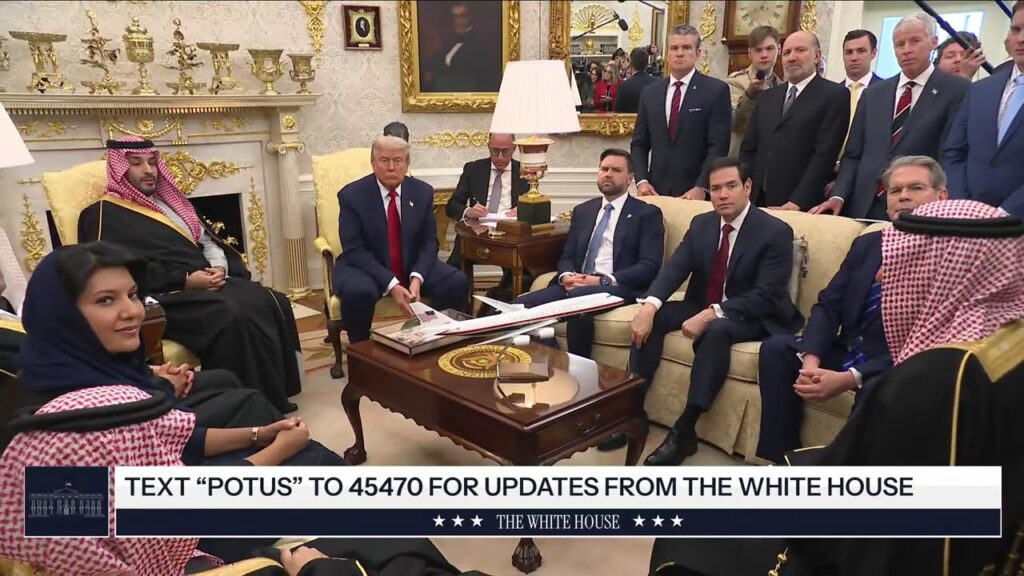
The timing of the meeting is significant. In an era where Saudi Arabia is seeking to diversify its economy beyond oil, and the United States is seeking reliable and forward‑looking partners in a volatile region, this bilateral talks signal a recalibration. For the United States, deepening ties with Saudi Arabia can help project influence, access strategic resources, and further defence cooperation. For Saudi Arabia, the partnership offers legitimacy, Western markets, and technology transfer. The public messages both leaders offered emphasise unity of purpose — phrases such as “strong partnership”, “shared future”, and “economic reform” pepper the remarks.
Yet the optics of the meeting also carry weight. President Trump uses the event to showcase American leadership, emphasise American jobs, and frame the bilateral relationship as beneficial to the U.S. national interest — referring to the job creation in America and the investment opportunities for America. In his remarks, Trump stresses that new commercial deals will support American workers and that Saudi economic reforms align with U.S. interests. The American Presidency Project From the Saudi side, Crown Prince Mohammed bin Salman thanks the President for U.S. leadership and highlights his country’s reform agenda, the Crown Prince’s Vision 2030 strategy, and Saudi Arabia’s eagerness to open to foreign investment and innovation.
One notable theme in the meeting is change — change in how the Middle East is perceived, change in partner roles, and change in the nature of cooperation. Trump remarks in other contexts (though not necessarily this exact bilateral moment) that the Middle East should be defined by commerce, not conflict, by opportunity rather than division. Rev+1 That sentiment echoes in this bilateral meeting: the emphasis is on economy, infrastructure, jobs, and technology, alongside security. The notion is that the U.S.–Saudi partnership is no longer just about oil and arms but also about innovation and mutual growth.
From an analytical perspective, the meeting raises several interesting points of reflection:
- Economic leverage & investment: The fact that new commercial deals are tied to tens of thousands of U.S. jobs shows that the U.S. side is emphasising the domestic benefits of foreign partnerships. Saudi Arabia’s willingness to engage in large‑scale investment in the United States reflects its ambition to shift its economy and deepen re‑engagement with global markets.
- Security dimension: While the meeting is billed as economic and diplomatic, the security overlay cannot be ignored. Cooperation against Iran’s regional influence, stabilising Yemen, and more broadly aligning on defence issues were significant parts of the agenda. This underlines that even in an era of “economy first” diplomacy, traditional strategic concerns remain central.
- Soft power and image management: President Trump’s rhetoric and tone are carefully calibrated. He frames the U.S.–Saudi relationship as mutually beneficial, forward‑looking, and anchored in friendship and respect. For Saudi Arabia, being received by the U.S. President signals an endorsement of its reform trajectory and global legitimacy.
- Risks and criticisms: While much of the public narrative emphasises cooperation and progress, critics will point to human rights concerns in Saudi Arabia, the controversial Yemen war, and issues of governance. The meeting’s upbeat tone may, in some quarters, be viewed as glossing over these issues in favour of commercial and strategic gains. Observers will watch carefully how the stated ambitions (such as job creation and investment) translate into real outcomes, and whether deeper reforms follow.
- Regional context: The broader Middle East backdrop matters. With power balances shifting, energy markets evolving, and the US recalibrating its presence in the region, this bilateral meeting functions as a signal of continuity and change: continuity in alliances, change in modus operandi.
For viewers of the video, the key take‑aways are:
- The meeting is emblematic of a deepening U.S.–Saudi partnership under President Trump’s leadership and Crown Prince Mohammed’s reform‑minded agenda.
- It emphasises economic ties (investment, jobs, technology) as much as defence ties—reflecting a modernised diplomacy.
- The rhetoric speaks to optimism and forward momentum, though underlying tensions (regional instability, human rights) remain unresolved.
- The immediate deliverables mentioned — commercial deals, job support in America, Saudi investment — serve to ground the meeting in tangible benefits rather than purely symbolic gestures.
- The broader implication is that U.S. foreign policy (at least in this case) is positioning alliances like Saudi Arabia as strategic partners for growth, not just security.
In conclusion, this video presents a high‑profile diplomatic moment between President Trump and Crown Prince Mohammed bin Salman, offering insight into how bilateral diplomacy is playing out at the intersection of economy, security, and image. It is useful for anyone interested in U.S. foreign policy, Middle East geopolitics, Saudi economic transformation, or the broader narrative of how major powers manage strategic partnerships. Watching the meeting gives you direct access to the public messaging and lets you evaluate how the leadership frames the cooperation. If you’re looking into how economic diplomacy and strategic alliances are evolving in the 2020s, this is a prime example.