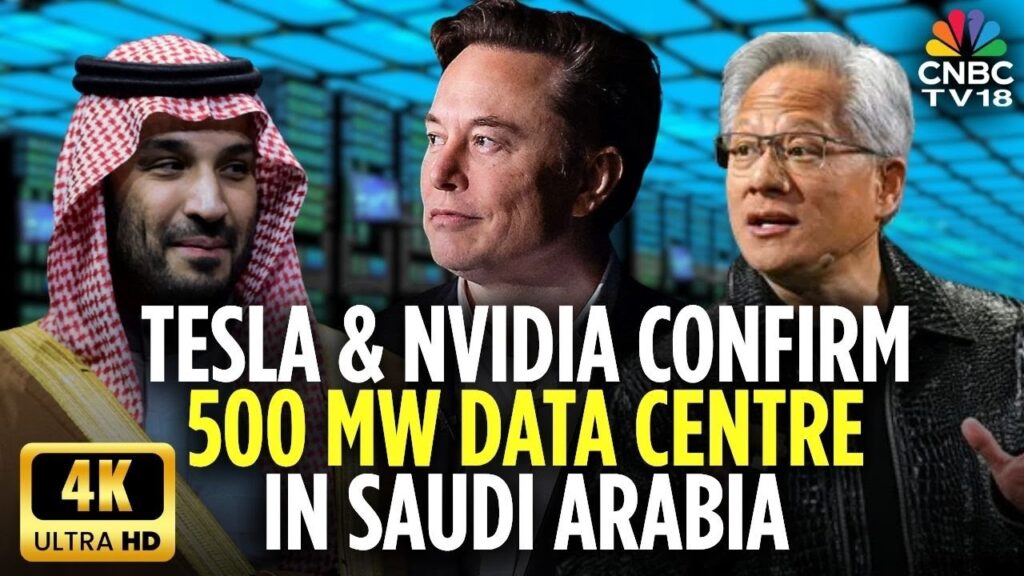
In this video, we witness a major development in global artificial intelligence infrastructure as Elon Musk (CEO of Tesla, Inc., among other ventures) and Jensen Huang (CEO of NVIDIA Corporation) announce a strategic collaboration with Humain, a Saudi Arabian AI startup backed by the kingdom’s sovereign investment fund. The deal signals a bold move by Saudi Arabia to ramp up its AI infrastructure, and marks a significant step for Musk and Huang in extending their AI ambitions globally.
The narrative begins by placing the players: Elon Musk is known for his leadership at Tesla, SpaceX and his emergent AI company xAI. Jensen Huang heads NVIDIA, a leader in semiconductor hardware and AI accelerators. Humain, founded in May 2025 and owned by Saudi Arabia’s Public Investment Fund, is tasked with transforming the kingdom into a global AI hub. Wikipedia+1
The core of the announcement reveals that Musk’s and Huang’s firms will collaborate with Humain to build large-scale AI infrastructure in Saudi Arabia. This includes a data centre project with a capacity of up to 500 megawatts, powered by NVIDIA’s advanced AI chips, with xAI’s models and Musk’s technology playing a role in the deployment. Stocktwits+2New York Post+2
An important angle: the initiative was unveiled at a U.S.–Saudi investment forum, which underscores both the business and diplomatic dimensions of the deal. Musk and Huang appeared together in a panel discussing AI architecture, models and investment flows tied to the Saudi kingdom’s ambitions. Reuters+1
The video then dives into the strategic rationale: for Saudi Arabia, heavily reliant on oil revenues and seeking diversification, AI infrastructure is a way to secure a position in the next wave of global technology competition. Humain aims to process a significant share of global AI workloads, build huge data-centre parks, and partner with major U.S. tech firms. Financial Times+1
From Musk’s viewpoint, the deal gives his AI operations access to massive compute and energy resources outside the U.S., enabling scale that might otherwise be difficult to achieve. For NVIDIA and Jensen Huang, the collaboration extends the company’s hardware reach into new geographic markets and reinforces its role as the de facto backbone of modern AI. The deal also reflects the increasingly global—and geopolitically charged—nature of AI infrastructure build-out.
The video explores potential implications:
- Compute scale: The 500-megawatt figure (with reports of first phases at 50 MW) represents an enormous investment in data-centre infrastructure. Stocktwits+1
- Chip supply & export controls: The deal raises critical issues around the export of advanced AI semiconductors to the Middle East, and how U.S. policy may adapt. New York Post
- Global AI competition: By moving infrastructure into Saudi Arabia, Musk and Huang signal that the centre of gravity for AI may extend beyond the U.S., Europe and China into the Middle East. Saudi Arabia hopes to capture a meaningful share of AI-workload processing. Financial Times
- Energy & land advantage: The kingdom’s abundant land and low-cost energy (including renewable power) make it a competitive location for sprawling data centres that have massive power and cooling needs.
- Regional strategic effect: The collaboration also reflects broader trends of tech firms engaging with Middle Eastern sovereign funds and governments to finance and build infrastructure at scale.
The video likely offers commentary on the risks: geopolitics, human-rights concerns, the technical challenge of scaling AI infrastructure, and whether such a big project can be delivered on time and at cost. It might also discuss how Musk’s xAI and Tesla’s own AI efforts intertwine with this deal, and how NVIDIA’s hardware roadmap aligns with Humain’s ambitions.
The conclusion emphasises that this announcement is not just a deal-making moment, but a sign of how AI infrastructure is shifting. The roles of compute, data-centre scale, sovereign wealth funds and global partnerships are converging. For viewers, the key takeaway is that the AI race is being re-written – it’s no longer just about models, it’s about where the massive compute lives, who controls it, and how it’s financed.
Why this channel/video matters
- It features two of the most influential tech figures of our time — Elon Musk and Jensen Huang — coming together in a major international infrastructure partnership.
- It reveals Saudi Arabia’s ambitions in AI in a concrete form (via Humain) rather than just rhetoric.
- It brings into focus lesser-seen risks and opportunities of the AI boom: energy consumption, global infrastructure, export controls, geopolitical strategy.
- It helps viewers understand that the ‘AI race’ isn’t simply about software and models — it’s very physical: data centres, chips, power, and partnerships.
Viewer tips
- Pay attention to the timeline: when the project phases begin (50 MW, 500 MW) and how quickly the infrastructure might roll out.
- Note the hardware: NVIDIA’s chips and architecture are key; the video might mention models like “Blackwell” or GB300. AP News
- Consider the players: Musk’s xAI, NVIDIA’s scaling strategy, Humain’s role in Saudi Arabia’s AI ecosystem.
- Reflect on the broader context: What does this mean for outside players (U.S., Europe, China) in AI infrastructure?
- Think about the implications: Will this spur more global build-outs? How will regulation, export controls, and national strategies shape future deals?