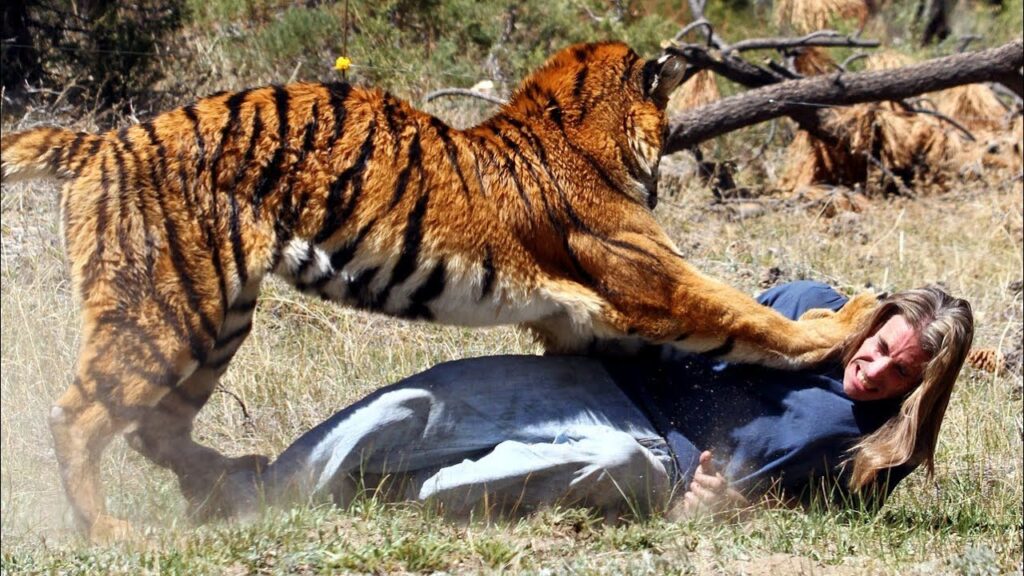
In the heart-stopping video “Tiger Attacks, Drags Trainer”, viewers witness a terrifying moment that underscores the immense risk when humans work closely with wild animals. The footage, taken at the Pensacola Interstate Fair in Florida, shows a two-year-old Bengal tiger named Gandhi suddenly turning on its trainer, Vicenta Pages, and dragging her around its performance pen. YouTube+2TheMix.net+2
The incident begins innocently enough, with Pages inside the tiger enclosure, interacting with Gandhi in front of an audience — including a group of schoolchildren on a field trip. UPROXX But then, very quickly, things escalate. The tiger grabs hold of her leg, bringing her to the ground. Pages tries to fend the animal off, first with her hands, then with a stick. Meanwhile, her husband rushes into the cage, hitting Gandhi with a stick in an attempt to free her. The scene is chaotic, dangerous, and deeply unsettling. UPROXX
As Gandhi drags Pages around, the trainer’s vulnerability becomes painfully obvious. The tiger’s strength and raw power dominate the interaction, even as onlookers scream and rush. According to reports, she sustained lacerations and was hospitalized. YouTube+1
This incident is more than just a freak accident; it’s emblematic of a larger, far more troubling dynamic between humans and wild animals in entertainment settings. Animals like Gandhi are powerful predators — not domestic pets. Even with training, the risk remains very real. This was not the first time something like this has happened in the world of big‑cat performances. Humane World for Animals+1
One reason these situations can become so dangerous is stress and provocation. Some experts argue that tigers used in circuses or fair shows may feel threatened or confined, which might provoke defensive behavior. PETA For example, PETA covered a similar incident where a distressed tiger at an Italian circus attacked its trainer. PETA
On the human side, the allure of working with big cats is powerful — there’s fame, spectacle, and a kind of mystique. But with that comes enormous risk. People like Pages or other animal trainers often form a kind of bond with these creatures, but no bond is foolproof. Predators are unpredictable by nature, and even well-trained ones can act on instinct when something triggers them.
Public reaction to the video was immediate and visceral. According to coverage by Uproxx, viewers were horrified. UPROXX Some saw the attack as a mistake — a mix-up in “play” that got out of hand. According to a publicist for the fair, Pages had been “playing” with Gandhi just before the attack; it’s possible the tiger misinterpreted her energy. UPROXX Others, though, highlighted a darker point: putting a wild animal in a confined space for performance is inherently risky. UPROXX
Beyond the immediate drama, we also need to consider the ethics of animal performances. When wild, powerful creatures are forced into entertainment, questions arise about their well‑being, their treatment, and whether such shows should continue at all. Documentaries like Living with Tigers and reporting on big‑cat incidents have repeatedly shown that these animals suffer under human control. Wikipedia+1
A look at the bigger picture reveals many similar cases. For instance, in 2003, Siegfried & Roy, the famous magic duo, had a dramatic tiger attack. A white tiger named Mantacore bit Roy Horn’s neck and dragged him off stage — a moment that shocked audiences around the world. Wikipedia More recently, in 2023, another trainer, Ivan Orfei, was attacked by a tiger in Italy during a live show. Bol News These stories underscore how dangerous it can be when wild cats perform for entertainment.
What can we learn from the video “Tiger Attacks, Drags Trainer”? First, it’s a stark reminder of the brute force these animals possess, and how even a small shift in mood or misunderstanding can lead to a serious incident. Second, it raises ethical questions: should wild animals be used for entertainment? And third, it emphasizes the need for better safety protocols, not just for the humans but also for the animals.
For anyone watching this video, it’s hard not to feel a mix of shock, sympathy, and concern. Shock at how fast the situation escalated. Sympathy for Pages, who risked her safety to do her job. And concern for Gandhi, who might have acted out of confusion, fear, or instinct — not cruelty.
Ultimately, the video is more than a sensational clip. It’s a call to reflect on the way we interact with wild animals, especially in entertainment. It pushes us to ask hard questions about control, respect, and responsibility. Are we respecting these powerful creatures enough to treat them as living, feeling beings — or are they just performing props? And is any spectacle worth risking a life — human or animal?